Antifungal and Antioxidant Activities of Ocimum basilicum and Ocimum gratissimum Essential Oils and Their Emulsions against Selected Trichophyton species
Evariste Josué Momo
Laboratory of Biochemistry, Faculty of Science, University of Douala, P.O. Box 24157, Douala, Cameroon and Laboratory of Biodiversity, Phytopharmacology and Pharmacopoeia (LaB2P), Higher Teacher Training College, Bertoua (HTTC), University of Bertoua, P.O. Box 652, Bertoua, Cameroon.
Francine Pamela Kamsu Noumegna
Laboratory of Biochemistry, Faculty of Science, University of Douala, P.O. Box 24157, Douala, Cameroon.
Sandrine Njuenkou Possi
Laboratory of Pharmacognosy, Faculty of Pharmacy, University of the Mountain, P.O. Box 208, Bangangté, Cameroon.
Boniface Pone Kamdem
*

Laboratory for Phytobiochemistry and Medicinal Plants Studies, Antimicrobial and Biocontrol Agents Unit (AmBcAU), Department of Biochemistry, Faculty of Science, University of Yaounde I, P.O. Box 812, Yaounde, Cameroon and Advanced Research and Health Innovation Hub, P.O. Box 20133, Yaounde, Cameroon.
Pierre Michel Jazet Dongmo *
Laboratory of Biochemistry, Faculty of Science, University of Douala, P.O. Box 24157, Douala, Cameroon.
Fabrice Fekam Boyom
Laboratory for Phytobiochemistry and Medicinal Plants Studies, Antimicrobial and Biocontrol Agents Unit (AmBcAU), Department of Biochemistry, Faculty of Science, University of Yaounde I, P.O. Box 812, Yaounde, Cameroon and Advanced Research and Health Innovation Hub, P.O. Box 20133, Yaounde, Cameroon.
*Author to whom correspondence should be addressed.
Abstract
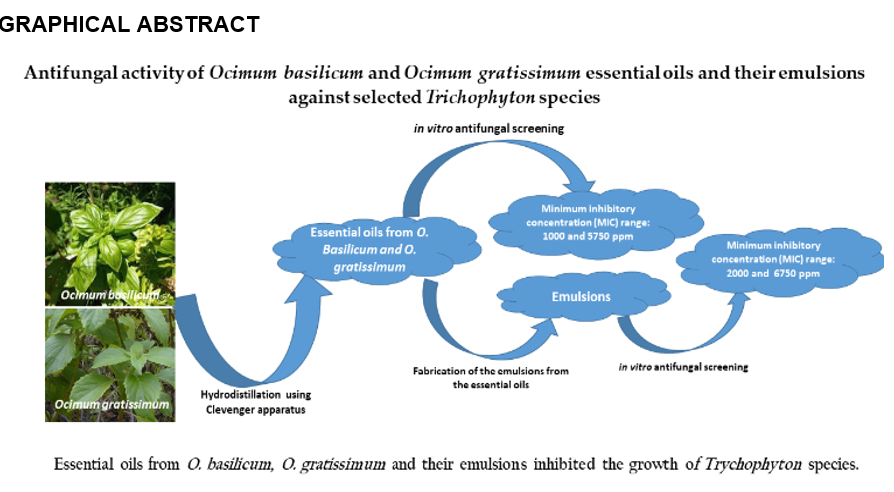
The outcome of antifungal treatments is hindered by various conditions, such as resistance and tolerance of certain fungal pathogens. Mycoses of nails and skin, which are primarily caused by dermatophytes, are the most common fungal infections, with Trichophyton rubrum being the most common dermatophytic pathogen, followed by Trichophyton interdigitale. Thus, the search for effective treatments against dermatophyte infections is valuable. Oxidative stress has intricately been involved in the pathogenesis of fungal infections. Therefore, the use of antioxidants to neutralize free radicals produced during the pathogenesis of mucoses would be beneficial for the treatment of fungal infections. This study is sought to investigate the antidermatophytic and antioxidant activities of essential oils and emulsions of the leaves and stems from Ocimum gratissimum and Ocimum basilicum. The plants’ essential oils, which were obtained by hydrodistillation using a Clevenger-type apparatus, were further analyzed by gas chromatography and gas chromatography coupled with spectrometry mass (GC/MS). The emulsions were obtained by spontaneous emulsification using Tween 80 and their stabilities were evaluated using distilled water and methylene blue dye. The antidermatophytic effects of the essential oils were evaluated using an agar diffusion method and by determination of minimum inhibitory concentrations (MICs). The antioxidant activity was carried out by the 2,2-diphenyl-1-picrylhydrazyl (DPPH) colorimetric method. As a result, the GC/MS analysis of essential oil from O. gratissimum revealed the presence of γ-terpinene (33.73%), thymol (26.44%) and 1.8 cineol (16.65%), whereas the O. basilicum’s essential oil was dominated by linalool (55.32%), eucalyptol (16.78%) and eugenol (7.45%). Essential oils and emulsions from O. gratissimum (MICs : 1000 and 2000 ppm, respectively) and O. basilicum (MICs : 5750 and 6750 ppm, respectively) revealed fungicidal activity against Trichophyton rubrum, whereas only O. gratissimum showed moderate activity against T. interdigitale. Moreover, essential oils and emulsions from O. gratissimum and O. basilicum scavenged the free radicals of DPPH, thus revealing antioxidant activity. This novel contribution demonstrates the antidermatophytic activity of essential oils and emulsions from O. gratissimum and O. basilicum, thus supporting the traditional use of these plants in ethnomedicine.
Keywords: Dermatophyte infections, Trichophyton species, Ocimum gratissimum, Ocimum basilicum, essential oils, emulsions